
Carthage Court Docket Searches
Carthage offers no official online municipal docket or citation-payment portal. Go through the City Court Clerk instead. The Tennessee court-clerk directory lists the city court at 314 Spring Street, P.O. Box 259, Carthage, Tennessee, with the phone number (615) 735-2525. Staff assignments shift. Call and confirm the current clerk, the next City Court date, and how you can view a public docket.
Read the label on the citation, summons, or notice carefully. A Carthage mailing address alone does not put the case in Carthage City Court. The matter could sit with a Smith County court. Or the ticket may have come from another town entirely.
- Read the issuing agency and court name.
- Collect the citation or case number and approximate date.
- Call the Carthage City Court contact for a municipal case.
- Ask for the next setting, docket inspection route, or copy type.
- If it is a county case, contact the proper Smith County clerk.
Carthage Court Records and County Seat
Carthage is the Smith County seat and its largest incorporated place. The 2020 Census place table counts 2,291 residents there. That explains why so many county court searches carry a Carthage address, but a town address never makes a county case a city case. Population says nothing about the volume of Carthage court records or the workload of any court.
Government level is what matters here. Carthage City Court handles the municipal lane, while Smith County General Sessions, Circuit, Criminal, Chancery, Probate, and Juvenile functions sit with other jurisdictions and other clerks.
Inside the Carthage Municipal Court
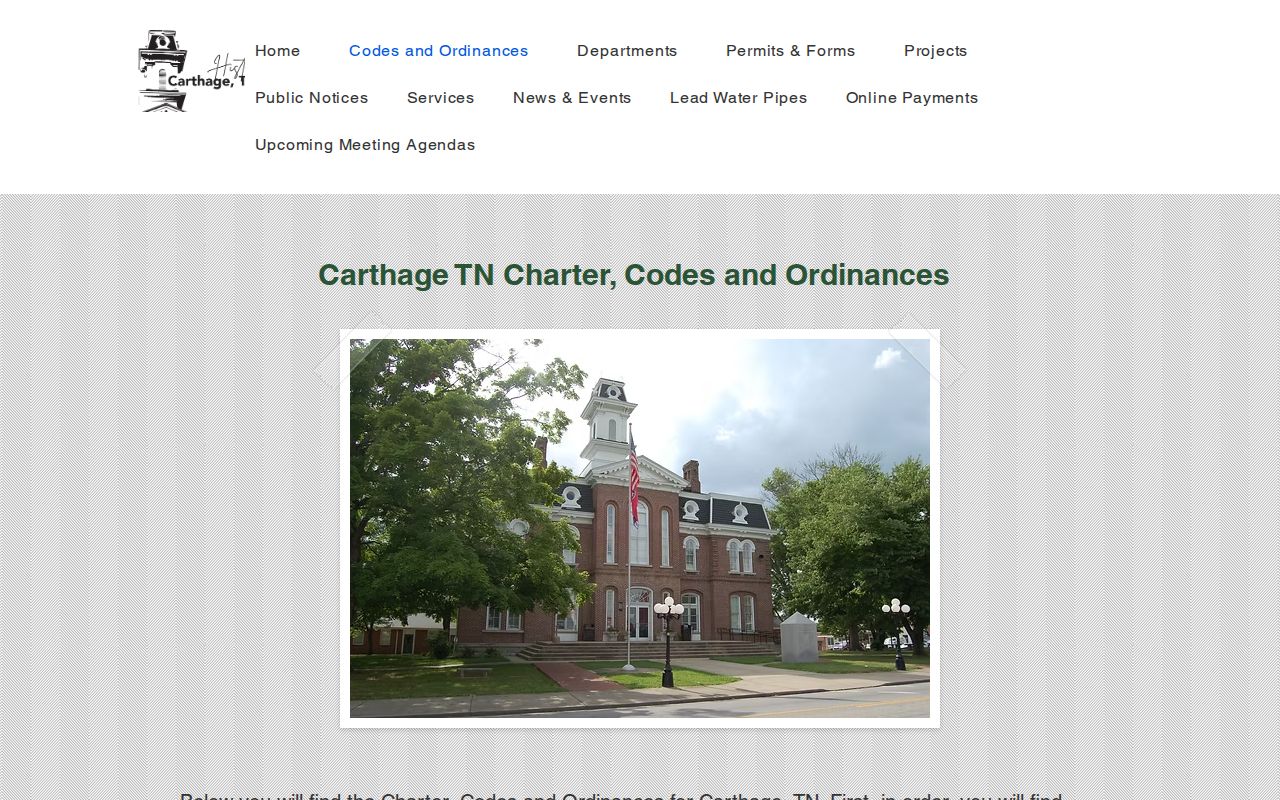
The town's Carthage Codes and Ordinances page links to the charter and the municipal code. Title 3 covers the Municipal Court. That structure tells you how the local court is organized and gives you ordinance text. But it is not a live list of Carthage cases. It cannot show whether a charge was filed, paid, dismissed, reset, or decided.
The code still serves a purpose. You can use it to identify the town rule named on a citation. Then request the matching Carthage court record. The docket request itself goes to the City Court Clerk. The city publishes no online docket archive, public terminal schedule, online plea system, or copy-fee schedule. In short, nothing is posted for case lookup.
Before calling, check the official Carthage code page. It lays out the charter and ordinance text.
Code reading and docket searching are different jobs. One tells you what the town rule says; only the clerk can confirm an actual case.
Carthage Court Records From Ordinances
A 2016 Carthage fireworks ordinance shows how a local rule can land a case in City Court. The official ordinance states that a violation may be cited into City Court. It is a piece of municipal law, not a sample Carthage court docket. It proves nothing about any named person's case.
The path matters when your citation cites a town ordinance rather than a state offense. Start with Carthage City Court and give the citation number. Ask the clerk to confirm the setting. Also ask whether a plain or certified Carthage court record is available. If the paperwork names Smith County General Sessions, take the county route instead. The wording on the paper controls, not your home address.
Finding Carthage Court Dates
Carthage publishes no confirmed municipal session schedule. Do not borrow the Smith County General Sessions calendar for city matters. The county page puts traffic settings on first and third Tuesdays at 9:00 a.m., but no city source says Carthage City Court follows that pattern. Call the city court contact before you travel or pay anything.
| Date | Ask the Carthage clerk to confirm the current setting. |
|---|---|
| Time | Confirm whether it is a docket call or case-specific time. |
| Location | Use the location supplied for the Carthage setting. |
| Court | Check for Carthage City Court rather than a county court. |
| Setting | Ask whether the event is a hearing, trial, review, or reset. |
A setting is only a scheduled event, not a result. A reset moves the event forward and never means the Carthage case was dismissed, so keep the clerk's confirmation with your citation.
Carthage Court Records and Two Addresses
Carthage looks like classic courthouse country. But record routing follows the named office rather than the scenery. The town's own history traces its founding to 1804, on the Cumberland River near the Caney Fork junction. A 2025 Smith County notice describes window work at the Historic Smith County Courthouse, 211 Main Street North. Current county clerk pages point users to 322 Justice Drive.
None of that settles where a current Carthage City Court hearing will happen. The historic building is civic context, and Justice Drive is the county court-office route. A municipal notice may name a different site altogether. So read the court name on your paperwork. Then confirm the venue with the office that set the case.
Myth: every court matter in the county seat goes to the historic courthouse.
Fact: Carthage, county, and historic-building references differ; the current notice and clerk control.
Carthage Traffic Ticket Lookups
Start with the municipal channel when a Carthage officer writes a ticket into City Court. The citation lists the agency, the court line, a citation number, and any appearance instructions. Read all of it. Before acting, call (615) 735-2525. Confirm the court's current contact while asking how Carthage traffic court records can be checked. The town posts no official citation lookup or online payment portal.
The county's CourtFeePay service is a different animal. Its Smith County source ties it to Circuit and General Sessions functions, not to City Court. So do not assume it will take a Carthage municipal ticket. Confirm the deadline, the payment method, and the payee with the town itself. A county ticket travels the separate Smith County traffic court records route.
Paying clears what you owe. It does not hand you the docket. For a hearing history, a disposition, or a copy of anything, ask the Carthage clerk directly.
Carthage Court Records or County Records
One town name can sit on several different records. So figure out which office holds yours before you search a docket. A citation from the city goes to City Court. Smith County General Sessions takes county traffic. It also handles the misdemeanors within its jurisdiction, civil matters under its stated limit, and the early steps of a felony. Above that sit the Circuit and Criminal cases kept by the Circuit Court Clerk. Chancery and Probate files stay with the Clerk and Master.
| Paper says | First route | Do not assume |
|---|---|---|
| Carthage City Court | City Court Clerk | County folder covers it |
| Smith General Sessions | Circuit Court Clerk | City schedule applies |
| Chancery or Probate | Clerk and Master | City Court holds it |
This comparison keeps a Carthage court-record request narrow and reduces transfers among offices.
How Carthage Cases Reach the County
Not every Carthage case is filed at Carthage City Court. The matter can rise to the county level. When it does, even events that happened in town go through Smith County courts instead. A felony may open with a General Sessions preliminary stage. It then moves on toward grand-jury and trial-court work. Chancery and Probate sit with a different clerk altogether.
Docket flow: Carthage Municipal Court › Smith County Courts › Circuit Court, 15th Judicial District
Treat this flow as a routing aid, nothing more. It does not claim every municipal citation climbs all the way to Circuit Court. Stop at the first court that actually holds the matter. For cases above the town tier, the Smith County court docket overview walks through the county channels. TennesseeCaseFinder may list Circuit and General Sessions Civil cases. But it makes no claim to cover Carthage municipal work.
Carthage Court Record Terms
Knowing the vocabulary saves time with the Carthage clerk. A code names the conduct the town regulates. A docket records the procedural events, and a setting is one event placed on a court date. None of them, by itself, proves how the case finally came out.
- Charter
- The source that establishes town powers.
- Municipal code
- The organized Carthage ordinances, including Title 3.
- Ordinance
- A local law adopted by the town.
- Citation
- A notice that may identify the rule, court, and response date.
- Disposition
- An outcome entry best checked against the order.
Match the words printed on your notice. Ask the clerk whether you are getting a setting, a docket entry, or the underlying document.
Requesting Carthage Court Record Copies
A tight request gets better results from Carthage staff. Name Carthage City Court. Give the citation or case number if you have it. Add an approximate date, and say exactly which item you want. Ask whether inspection, a plain copy, or a certified copy is offered. The town publishes no copy-fee schedule. So get the current amount and the accepted payment method straight from the clerk.
The town website gives a general contact route. Its form collects a name, email, subject, and message, nothing more. It advertises no case lookup, no document upload, and no secure docket service. So use it simply to ask where a records request should go. Keep any private case narrative or sensitive identifiers out of that general form.
For mail or a visit, verify the address and hours first. Ask how the office responds if part of the Carthage file turns out to be restricted. A plain copy just reproduces an available record. A certified copy carries the clerk's formal certification. So state which you need rather than assuming one price covers both. Audio is its own question: ask whether a recording or transcript exists and which office handles it. Tennessee Rule 26 governs official electronic recordings. But that statewide rule cannot prove a recording was ever made in a particular Carthage matter.
Keep proof of your request and any quoted fee. When staff cannot locate the Carthage case, recheck the court name and the issuing agency before you change search terms. A failed city search usually means a jurisdiction mismatch, not a case that vanished.
Who Can See Carthage Court Records
Tennessee Supreme Court Rule 34 starts from public access to court public records. Exceptions sit layered on top. It reaches the public parts of Carthage court records but opens no document wholesale. Sealed or protected files, internal case-management material, judicial drafts, and confidential information can all be withheld. Juvenile material faces added limits.
Key access rules:
Tennessee Supreme Court Rule 34 sets the court-record framework and recognizes exceptions.
The Tennessee Public Records Act supplies a statutory inspection route, while court rules govern court files.
Tennessee expungement guidance says eligible records require a court process and are not cleared automatically.
Ask the Carthage custodian which portion is public and whether a redacted copy can be made. A docket line you can see does not guarantee its filing or exhibit is available.
When Carthage Court Records Do Not Match
When a search comes up empty, check jurisdiction before casting a wider net. Compare the issuing agency, the court name, and the citation date. Then ask the Carthage clerk. Ask whether that number format even belongs to City Court. If it does not, request the name of the office that received the case. That step matters. An old notice can show a Carthage address. But the case may actually sit in Smith County, so a missing online result should not be read as a dismissal. Only the Carthage court record, plus the clerk's current response, can confirm the procedural status.