
Traffic Case Records in Smith County
Smith County General Sessions Court hears traffic offenses. Its court-date and fee questions go through the Smith County Circuit Court Clerk. That one clerk office also backs Circuit, Criminal, and other General Sessions work. Even so, Traffic Court sits in its own local lane. A traffic case record may list several items. Those include a citation identifier, setting, court, plea, disposition, fine, or cost. The county's public date-PDF folder can help with a scheduled docket. However, it stops short of a full citation database.
A ticket written into Carthage, Gordonsville, or South Carthage city court stays a city matter. It does not become a Smith County General Sessions case just because the town sits inside county lines. Let the issuing agency and the court printed on the citation guide your first call.
Smith County Traffic Court Schedule
Smith County Traffic Court meets on the first and third Tuesdays of each month at 9:00 a.m., per the official county schedule. That session time is a recurring calendar fact. It does not prove a particular citation is still set for that day. A continuance, reset, payment, disposition, or clerk correction can all change the case record.
Quick answer: Use the Tuesday pattern to orient the search, then confirm the exact citation with the docket packet or Circuit Court Clerk before appearing.
The public Smith County court schedule adds more context on resets and other local court calendars.
Smith County Traffic Ticket Lookups
Begin with the ticket in hand. Smith County assigns citation and case numbers through the Circuit Court Clerk, and the county payment route expects a number before anything else. CourtFeePay handles payments only. It offers no public name search. The no-login county channel is the SC COURT DOCKETS folder, whose PDF packets are arranged by date and may not cover every court or final outcome.
- Read the citation to identify the issuing court, citation number, response date, and whether the matter is county or municipal.
- For Smith General Sessions, check the official date-based docket folder for the relevant session. Do not assume the scanned PDFs support text search.
- Use CourtFeePay only after selecting Tennessee, Smith County, and the correct court, and only when ready to review the payment flow.
- If the citation cannot be found, call the Circuit Court Clerk at (615) 735-0500 or visit Suite 115 at 322 Justice Drive.
- For a city citation, contact the named city court or city hall instead of forcing the number through the county route.
TennesseeCaseFinder covers Circuit and General Sessions-Civil cases behind account registration, per its own description. That scope does not amount to a general traffic-citation search. The statewide appellate Public Case History system serves appeals, not a first search for a local ticket.
Smith County CourtFeePay Fields
The verified Smith Sessions payment selection asks for the citation number plus several payer fields before any preview. Those fields exist to match and process a payment. They do not turn the vendor screen into an index of Smith County traffic court records.
| Field Group | Fields Seen in the Verified Flow | Purpose |
|---|---|---|
| Case identifier | Citation Number | Connects the payment to the court matter |
| License details | License State, License Number, Date of Birth | Supplies identifying data required by the form |
| Contact | Name, address, email confirmation, phone | Identifies the payer and receipt contact |
| Payment | Amount, Service Fee, Total Amount | Shows the sum before final submission |
| Consent | Terms and service-fee acknowledgments | Must be checked before payment preview |
The pre-entry screen posts no flat Smith County service fee. Check the live total before you submit a payment, and take any dispute about the amount owed straight to the local court. The Smith General Sessions CourtFeePay selection shows how this county-and-court payment lane works, which is narrower than a public search of every Smith County traffic case.
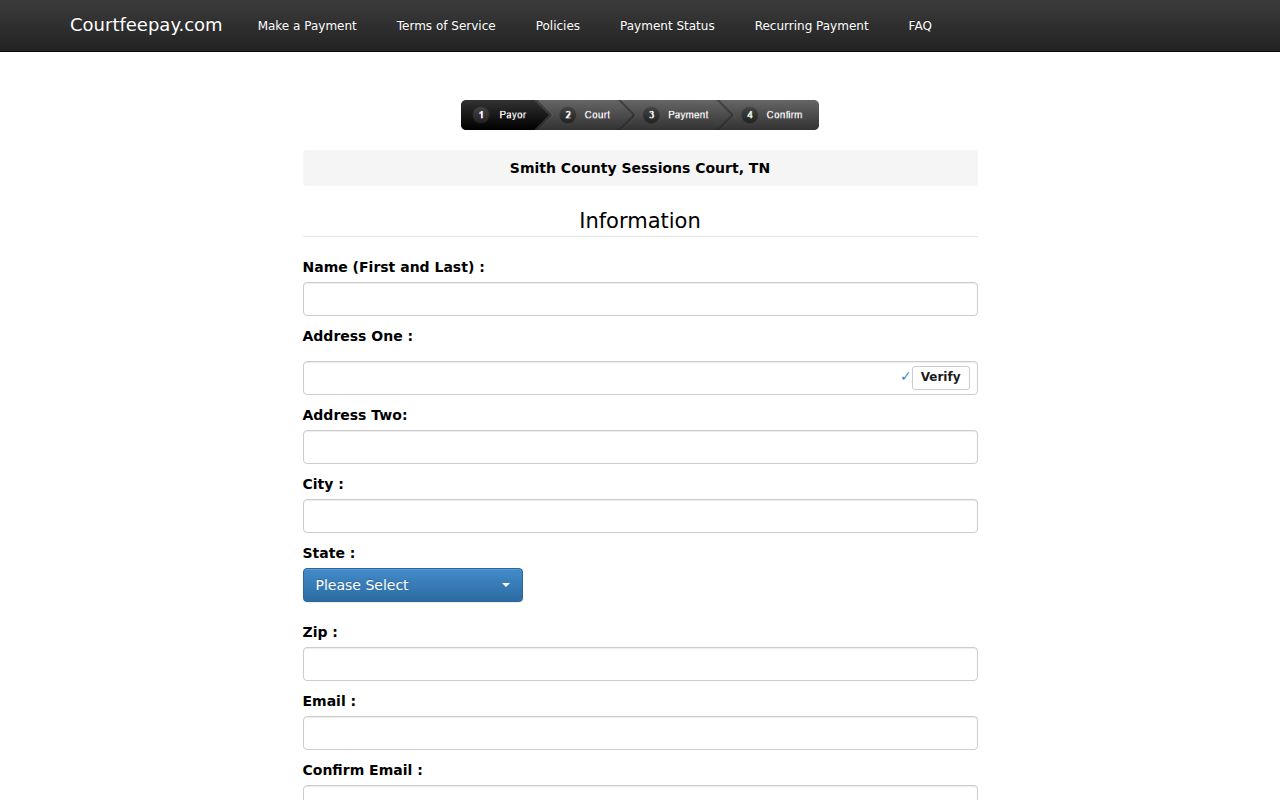
That payment lane is narrow. It covers one court's fee processing, not a public search of all Smith County traffic cases.
Traffic Court Dates in Smith County
A Smith County traffic citation may print an appearance or response date, while the court docket shows the live setting once the case is entered. Compare the two. If they clash, ask the clerk. The county's recurring first-and-third-Tuesday schedule cannot establish a specific courtroom call or confirm that a reset was entered.
| Citation Number | Use the exact clerk-assigned value shown on the ticket, represented here only as CITATION NUMBER. |
|---|---|
| Issuing Court | Distinguishes Smith General Sessions from Carthage, Gordonsville, or South Carthage city court. |
| Date and Time | Shows the listed setting, which should be checked for a later reset or continuance. |
| Setting Type | May describe an appearance, hearing, trial, review, or another court event. |
| Status or Disposition | Shows procedure or outcome when entered; confirm it against the clerk's official record. |
The county's PDF samples are image-only, so exact citation-number formatting and docket row labels stay unknown. No invented number pattern belongs on this page.
Smith County Municipal Ticket Routing
Three incorporated towns run their own municipal court channels. Each city publishes a different level of public detail. The Tennessee AOC clerk directory lists city court contacts for all of them. Carthage's code includes a Municipal Court title. South Carthage posts city contact information and a municipal code covering court and traffic topics. Neither city offers a public docket portal at this time.
- Carthage City Court: call (615) 735-2525 using the citation's municipal court details.
- Gordonsville City Court: its official administration page publishes a separate payment phone, court details, and an every-other-month hearing pattern.
- South Carthage City Court: call city hall at (615) 735-2727 because no public municipal citation search was located.
Gordonsville says its card company adds a 3.5% transaction charge. That city-specific amount does not apply to Smith County CourtFeePay. Nor does it apply to the other towns. Clerk names also conflict across current official sources for some cities. Call the published city number and confirm who holds the office today.
Paying a Ticket vs Fighting It
Paying and contesting lead to different court events. Confirm the deadline and allowed methods with the issuing court before you choose either path. Smith County documents CourtFeePay for county court payments. Its sources publish no single set of plea procedures covering every municipal citation. The payment vendor itself says amount disputes belong with the local court.
| Paying the Citation | Contesting the Citation |
|---|---|
| Uses the issuing court's approved payment channel | Requires a timely response to the issuing court |
| May result in a plea and disposition being entered | May lead to a hearing or trial setting |
| Requires the correct citation number and live total | Requires confirmation of the date, place, and filing method |
| Payment proof should be retained | Any reset should be checked with the clerk |
Failure to appear: Contact the local court first for the case status and any required release, reset, or satisfaction, then use TDOSHS for the separate state follow-up.
Smith County FTA Follow-Up
A failure-to-appear notice creates two tasks that travel together. First, clear the local court side through the clerk who holds the citation. Second, deal with any state licensing action. That goes through the Tennessee Department of Safety and Homeland Security. State guidance points to a court release, reset, or satisfaction and a 30-day FTA process. The court still decides what must happen in your Smith County case. The official Tennessee FTA support page explains the state's end of that process. It covers the temporary restricted license paper copy.
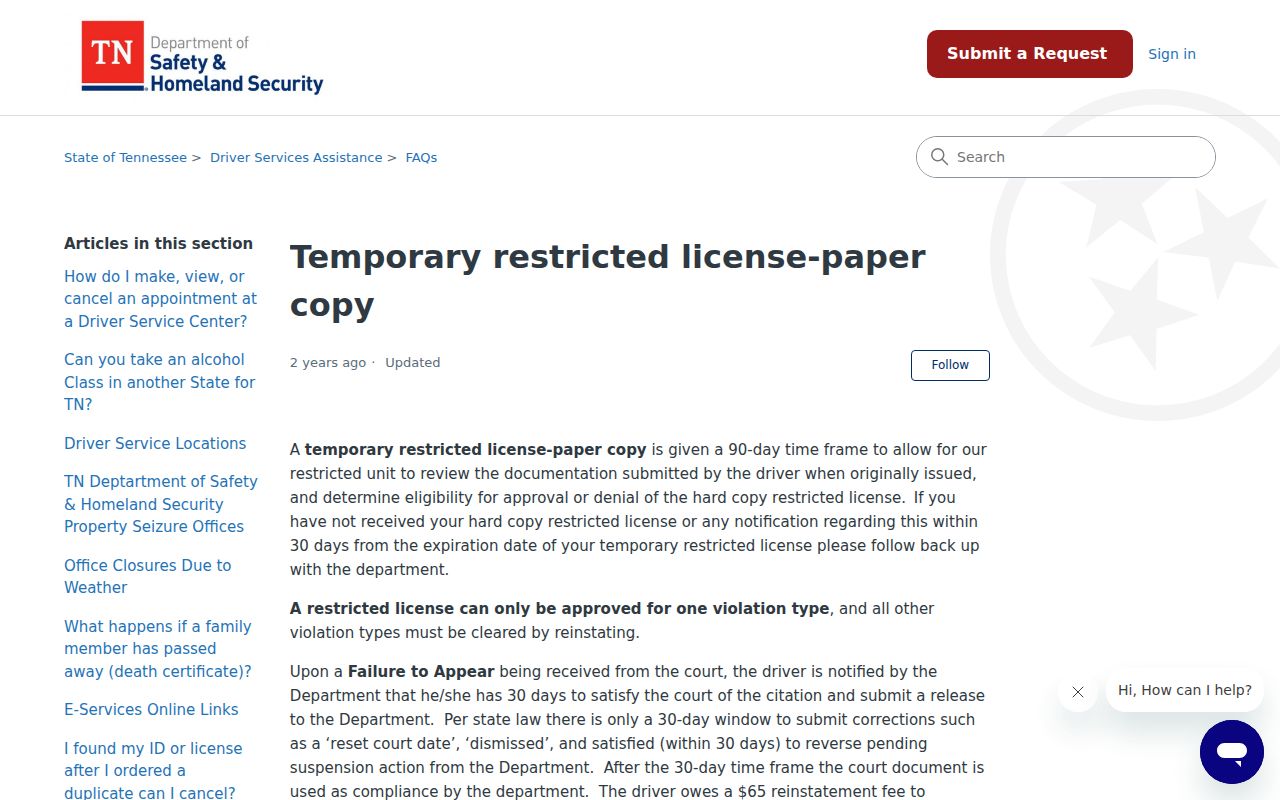
Follow the two-step order. First, get the local court action you need. Then confirm the separate state status with TDOSHS.
Never assume one payment cleared every case and every state consequence. Keep your receipt, plus any release or satisfaction the clerk issues. Then check each file with the office that keeps it.
Two Records: Court File and Driver File
A Smith County traffic court record and a Tennessee driver record are two different files. The court file lives with the Smith County Circuit Court Clerk. Or it may sit with the municipal clerk that heard the citation. TDOSHS keeps the driver file. A clerk can fix or document the local outcome. But only the state agency controls its own licensing record and process.
| Court Traffic Record | Driver Record | |
|---|---|---|
| Custodian | Smith County Circuit Court Clerk or issuing city clerk | Tennessee Department of Safety and Homeland Security |
| Main contents | Citation, settings, plea, disposition, fine, and court costs | State driving history and licensing actions reported through state systems |
| Correction route | Ask the court about its citation and entered disposition | Ask TDOSHS about the state-held file after local court action |
| Access route | Docket packet, clerk call, counter request, or court copy | TDOSHS driver-services channels |
One file can never stand in for the other. A missing result in the date-based court folder says nothing about what the state file holds, and a state status screen will not show the local plea or the signed court order.
Smith County Traffic Record Terms
Short labels on a traffic citation can hide very different stages of the case. When the live record is unclear, use the Smith County clerk's own wording and ask the office what an abbreviation means.
- Citation number
- The identifier assigned to the ticket and required by the county payment flow.
- Case number
- A court identifier that may differ from the number first printed on the citation.
- Setting
- A scheduled court event, not a final finding or disposition.
- Disposition
- The procedural or final outcome entered in the court record.
- FTA
- Failure to appear, which may require both local court action and separate state follow-up.
Traffic Record Copy Fees
Smith County posts no complete fee schedule for plain traffic-case copies, certified copies, or record searches. Court fines, costs, service fees, city card charges, and copy charges are all separate amounts. Before you order anything, ask the issuing court what a copy costs and how certification works.
| Item | Fee | Notes |
|---|---|---|
| Plain case copy | Not published | Ask the Smith County court clerk |
| Certified traffic record | Not published | State that certification is needed |
| CourtFeePay service fee | Calculated live | No flat county rate was verified |
| Gordonsville card payment | 3.5% | City card-company charge only |
The Circuit Court Clerk can confirm county copy charges and accepted payment routes. For a city case, ask the municipal clerk.
When Smith County Cannot Find a Ticket
A failed payment lookup does not mean the ticket vanished or was dismissed. Check the spelling and the citation number. Make sure Smith County issued it rather than a city court. Allow time for entry. Then call the clerk before the response date. The county's date folder may skip the division you need, or it may post an image no text search can read. Have the citation, the issuing agency, the issue date, your name as printed, and any court or response date ready. Never send license data through an unverified email address. The clerk can point you to a secure channel and tell you whether a case number exists yet.
Note: A payment portal failure, missing PDF row, and final dismissal are three different facts; only the issuing court can confirm the case.