
Smith County Court Record Requests
First figure out which division holds your file. That choice decides where a Smith County court docket request goes. The Smith County Circuit Court Clerk handles records and hearing dates for Circuit, Criminal, and General Sessions cases. Chancery and Probate files sit with the Clerk and Master instead. A city clerk keeps any municipal case. County sources describe online docket viewing, phone help, and counter service at the courthouse. No full mail or email request method is published. So call the clerk first before you mail anything.
- Write down the court, party or case style, case number if known, and an approximate filing or hearing date.
- Check the county's date-based online docket folder or TennesseeCaseFinder when the division falls within its stated coverage.
- Call the proper clerk to confirm custody, public status, available request channels, expected timing, and the current cost.
- Ask for inspection, a plain copy, a certified copy, a transcript, or an official recording with enough detail to distinguish the item.
- Follow the clerk's payment and delivery instructions. Verify that the copy is from the case and date intended.
What if you lack a case number? Start there. The Smith County docket search options walk through each public channel and where it falls short.
Smith County Court Record Custodians
One county name hides several records desks. Tommy Turner, the Smith County Circuit Court Clerk, is the first call for Circuit, Criminal, and General Sessions questions. He also covers court dates, citations, and fees. Jessie Goad serves as Clerk and Master. She keeps every Chancery and Probate record the county describes. Carthage, Gordonsville, and South Carthage each run their own city-court channel. The state's clerk finder offers simple advice: contact the clerk where the case began.
Smith County Circuit Court Clerk
322 Justice Drive, Suite 115
Carthage, TN 37030
(615) 735-0500
Monday-Friday, 8:00 a.m.-4:00 p.m.
Smith County Clerk and Master
322 Justice Drive, Suite 105
Carthage, TN 37030
(615) 735-2092
Monday-Friday, 8:00 a.m.-4:00 p.m.
The Tennessee judiciary's Smith County location record places the Circuit, Criminal, and Chancery courts on Justice Drive.
The official Circuit Court Clerk page for Smith County shows the clerk's contact details, office hours, and filing information for court records.
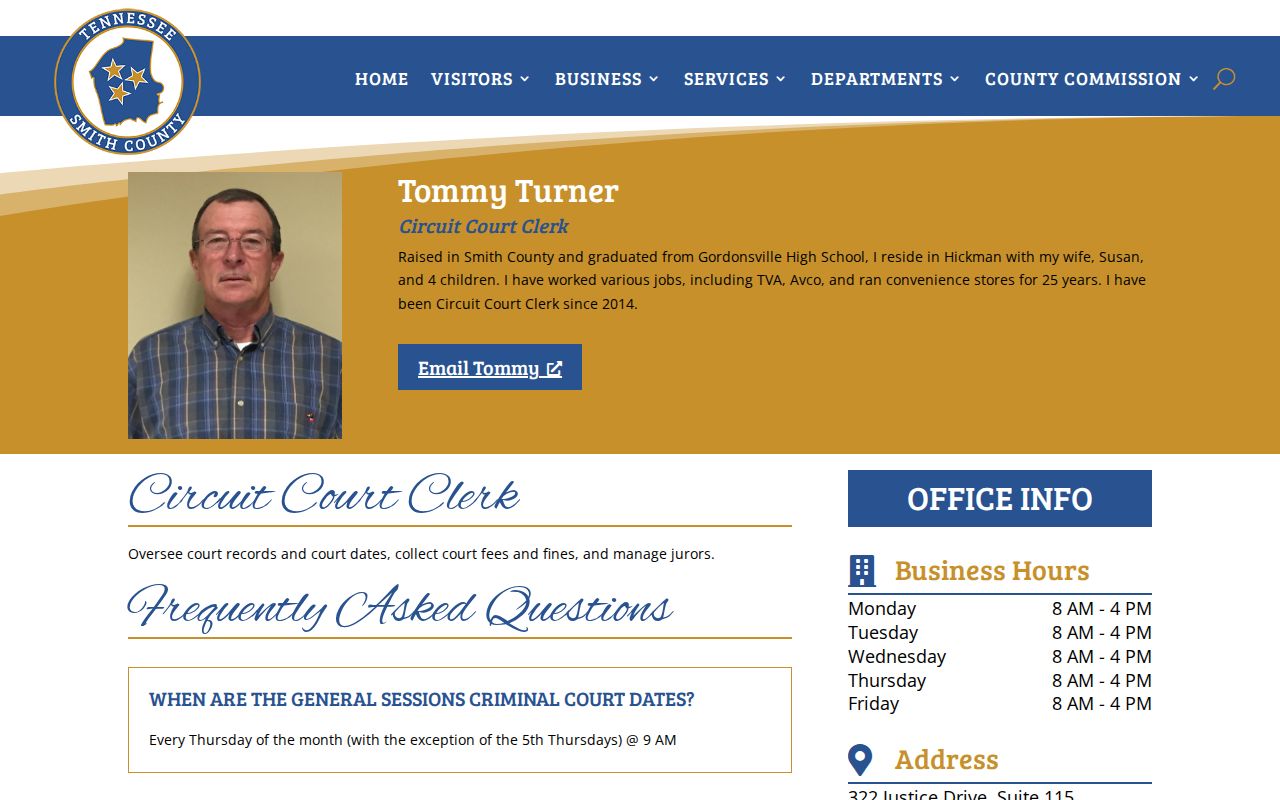
The clerk's office, not the general county line, handles Smith County court record requests. Call the county number and you will likely be routed to the clerk anyway, so start there when you need to confirm a file.
Kinds of Court Records
Smith County court records come in several shapes. The type of case plus the court that hears it decides what lands in the file. The docket is just one piece. Filed papers, transcripts, and recordings sit apart from it. Each may follow its own request process. These broad groups below describe what a court file can hold, though not every document in them is open to the public.
- Circuit and Criminal case files, including public motions, orders, judgments, and docket entries.
- General Sessions civil, criminal, and traffic records maintained through the Circuit Court Clerk lane.
- Chancery records for matters such as land disputes, name changes, conservatorships, and other equity cases.
- Probate files for estates, inventories, and appointments of executors or administrators.
- Municipal court records held by the issuing city, plus transcripts or recordings requested through the responsible court.
A deed, for its part, lives with the Register of Deeds, while vehicle and marriage records sit with the County Clerk. Neither office hands over a lawsuit's court file.
Smith County Docket Versus Case File
A docket answers one question. What did the court calendar show on a given day? The Smith County public docket folder is not a storage bin for documents. A full case file can hold a complaint, petition, summons, service return, motion, response, order, judgment, or exhibit. None of those papers appear in the scanned docket itself. TennesseeCaseFinder sits on top as an inquiry layer. Do not treat it as proof that every filed document in a Smith County case can be pulled down online.
| Public Docket Layer | Underlying Case File |
|---|---|
| Organized in date-named PDF packets | Organized under the clerk's case record |
| Helps confirm a setting or calendar entry | May contain pleadings, orders, judgments, and returns |
| Image scans may not support reliable keyword search | Inspection or copies depend on custody and access rules |
| Does not establish every division or final outcome | The clerk can identify the official, current record |
The county-linked SC COURT DOCKETS folder illustrates this date-first publication method.
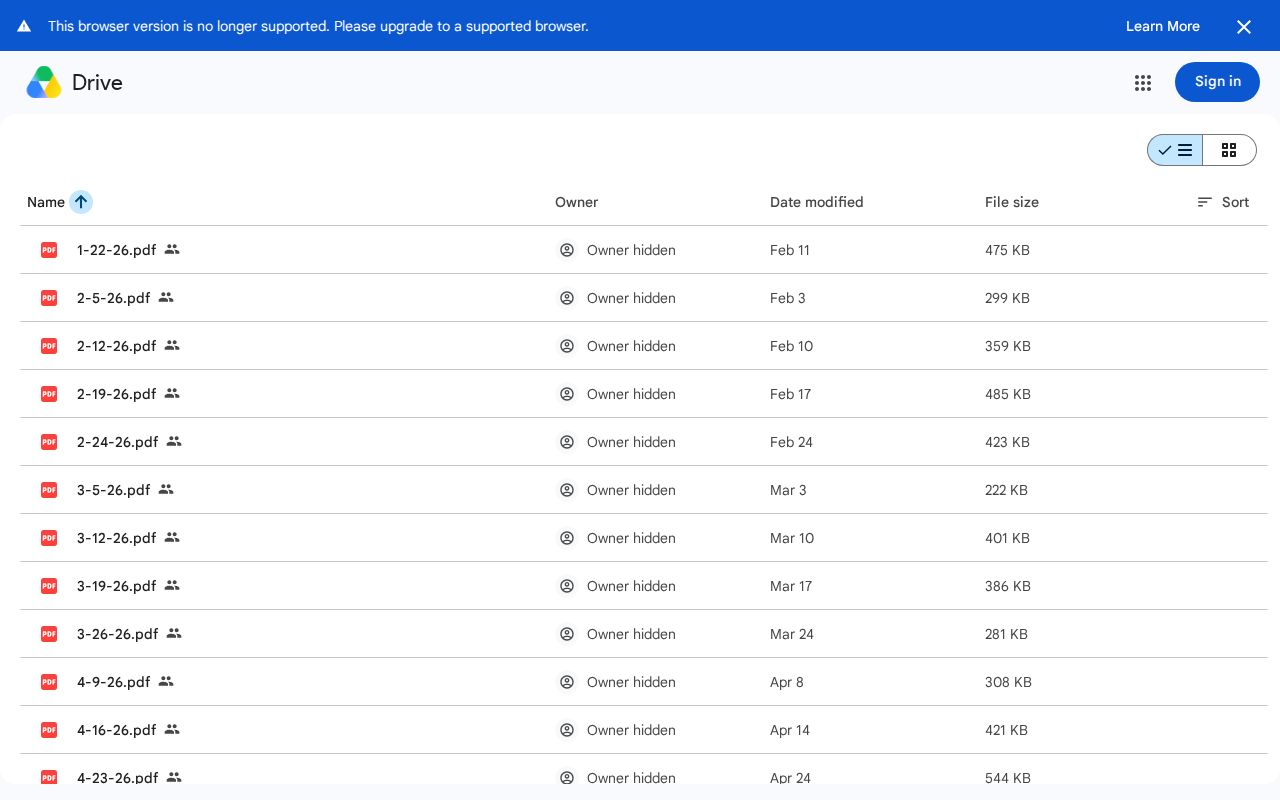
The case file matters most when you already know a court date and want the papers behind it. For anything the docket entry does not spell out, the clerk is still the place to ask.
Court Records: What They Contain
A Smith County court record can tell you who is involved in a case and where it stands. Some content stays closed to the public. Treat the labels below as categories for a request rather than a promise of what the file holds. The county docket scans carry no reliable text layer. So their exact row headings are anyone's guess. Once you know a case number, ask the clerk what actually sits in that file.
| Case identity | Court, division, case or docket number, filing date, and public case style when available. |
|---|---|
| Filed papers | Petitions, complaints, answers, motions, notices, and service records that are public in that matter. |
| Settings | Hearing dates, setting types, continuances, resets, and the assigned judge when shown. |
| Decisions | Public orders, judgments, and disposition entries, which should be checked against the signed document. |
| Other media | Exhibits, official recordings, or transcripts, each subject to its own custody and access process. |
Narrowing a Smith County Record Request
Clerks handle a narrow request faster. Say what you want up front: to inspect the file at the counter, to get a plain copy, to get a certified copy, or to ask whether a hearing was officially recorded. Give the court and case number if you have them. Add the document name and its filing date. No case number? Offer the case style and a tight date range instead. A broad fishing request slows everyone down. So keep the scope small.
- Custodian
- The office responsible for keeping the requested Smith County court record.
- Certified copy
- A copy authenticated by the clerk, rather than a plain photocopy or downloaded docket image.
- Segregable portion
- The public part that may remain available after protected content is withheld or redacted.
- Transcript
- A written account of a proceeding, which is not the same item as the docket or an official recording.
Recordings work differently. Under Tennessee Supreme Court Rule 26, a request for a recording or a transcript follows rules of its own, separate from an ordinary docket copy. Smith County publishes no local transcript form or price list.
Copy Fees and Certification
Smith County posts no current price list for copies of court case files. The same goes for certified copies, record searches, transcripts, and exemplified records. The county budget does mention copy-fee and court revenue lines. But a budget total is not what a requester pays at the counter. Ask the clerk to quote the cost before you place an order. Don't borrow a price from a nearby county. Fees differ from one office to the next.
| Requested Item | Verified Smith County Amount |
|---|---|
| Inspection of a public court record | Confirm availability and terms with the custodian |
| Plain paper or electronic copy | Current amount not published in reviewed sources |
| Certified or exemplified copy | Current amount not published in reviewed sources |
| Transcript or duplicate recording | Ask the clerk or responsible recording custodian |
CourtFeePay takes payments for fines and court costs. It is not the fee schedule for Smith County court record copies.
Smith County Open Records Policy
The county posts an Open Records Policy document. It spells out the local steps for making a request. Read it before you file anything. A request for a court file still goes to the office that holds that file. The policy cannot override Tennessee court rules. Nor can it override a sealing order or limits set by a particular division. The court pages offer no single universal request form. Confirm delivery methods and current response steps with the clerk directly.
County Clerk myth: The Smith County Clerk handles vehicles, marriage and business licenses, and commission functions. A court pleading belongs with the Circuit Court Clerk, Clerk and Master, or city clerk.
Access Rules for Court Records
Tennessee starts from the premise that court records are public. That does not mean every page in a file is open. Juvenile records can be limited. So can sealed material and expunged cases. Protected financial, medical, or identifying details can also be withheld. A docket entry may stay public even when a paper behind it is withheld. The reverse is true too. An expunction or sealing order can change what a docket search returns.
Key Tennessee rules:
Tennessee Supreme Court Rule 34 recognizes public inspection of court public records, subject to stated legal exceptions.
T.C.A. §§ 10-7-503 and 10-7-505 provide statutory starting points for public-record access and review of a denial.
Tennessee expungement guidance explains that relief applies only to eligible records and is not automatic.
Partial access: If part of a Smith County court record is sealed, you can still ask to view whatever pieces are public. The clerk can tell you what rule limits the file and why. What the clerk cannot do is give legal advice on challenging a restriction.
Smith County Records at Justice Drive
A 2025 county notice points to the Historic Smith County Courthouse at 211 Main Street North. Current official court and clerk pages send record users elsewhere: 322 Justice Drive. Inside, two suites split the work. Suite 115 handles the Circuit Court Clerk lane. Suite 105 handles the Clerk and Master lane. That short walk down a hallway carries a real legal distinction. Each office keeps its own records. Each answers only for its own custody. A docket search at the wrong window can dead-end quickly. Call ahead if your file is old. Do the same if it is held off site, confidential, or tied to Chancery or Probate. The posted hours cover the offices. They do not mean a requested court record will be ready the moment you arrive. The clerk posts no public terminal policy, copying-room procedure, parking directions, or general walk-in viewing schedule. Need an accommodation tied to a court proceeding? Smith County links an ADA modification form. It asks for the court, judge, case number, proceeding type, dates, and the change you want. It is not a records-request form. Review areas for the presiding judge and the Tennessee Administrative Office of the Courts appear on it too. That is what separates an access accommodation from a routine file-copy request at the clerk's counter.
Note: Confirm the correct suite, file availability, access status, delivery method, and price with the custodian before making a trip.